If you are reading this, I can almost guarantee you have a few band-aids on your fingers or a rip in your favorite pair of jeans.
I’ve been there. I’ve raised German Shepherds for over a decade, and I remember the exact moment with my first GSD, Kaiser, when I sat on the kitchen floor, near tears, thinking, “I think I brought home a wild animal.” He was growling, snapping, and seemed to target my ankles with the precision of a heat-seeking missile.
You likely searched for german shepherd puppy aggression because you are worried. You’re asking yourself if this is normal, or if you have a “bad dog” on your hands.
Here is the good news: True, pathological aggression in German Shepherd puppies is actually quite rare. What is common, however, is a high-drive, intelligent, mouthy breed that communicates through biting and lacks impulse control.
Let’s walk through what is really going on with your puppy, how to differentiate between a “Land Shark” and a serious problem, and the exact steps you need to take to fix it.
The “Land Shark” Reality: Is it Really Aggression?
Before we talk about fixing it, we have to define it. German Shepherds are herding dogs.1 They were bred to move sheep by nipping at heels and to protect their handlers with their teeth. When you combine that genetic history with the teething phase of a baby animal, you get a puppy that explores the world with its mouth.
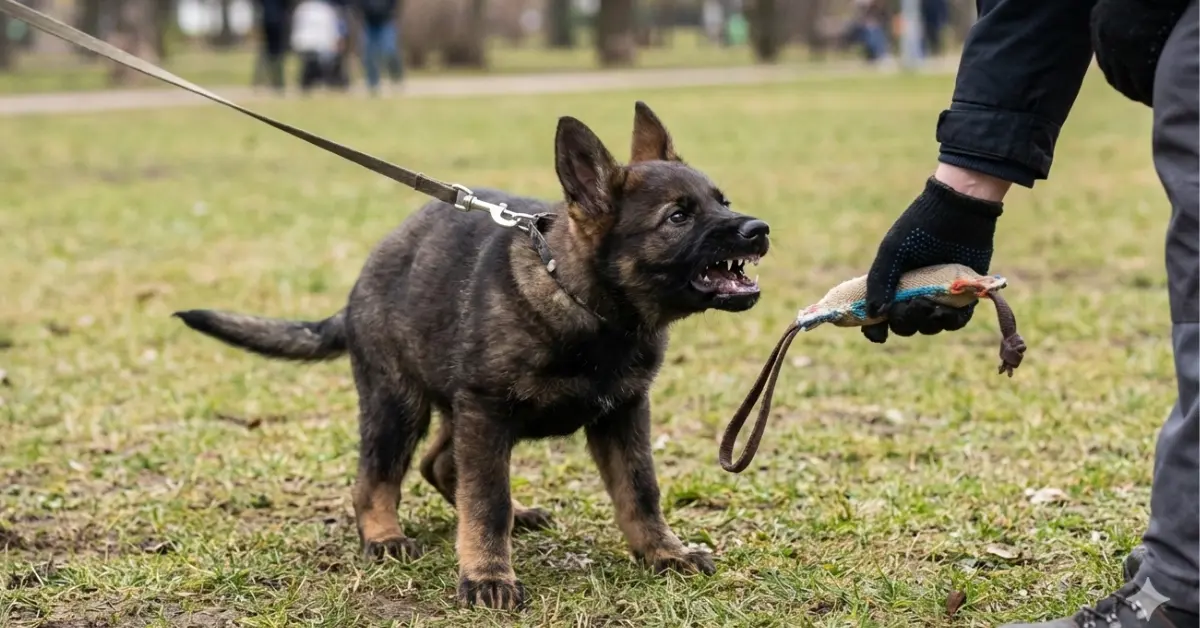
Most of what new owners call gsd puppy aggressive behaviour is actually just rough play or overstimulation.
How to Tell the Difference
I’ve seen hundreds of puppies, and learning to read their body language is the single most important skill you can develop.
It’s likely Normal Puppy “Brat” Behavior if:
- The body is loose and wiggly: Even if they are growling, their movements are bouncy.
- They sneeze: This is a universal dog signal for “I’m just playing!”
- They come back for more: They bite, you push them away, and they bounce back playfully.
- The growl is mid-to-high pitch: It sounds like a revving engine during tug-of-war.
It might be True Aggression if:
- The body goes stiff: The puppy freezes before snapping.
- Whale Eye: You can see the whites of their eyes (sclera) as they look at you sideways.
- Resource Guarding: They snap specifically when you touch their food, toy, or sleeping spot.
- The growl is low and guttural: It comes from deep in the chest and signals “back off.”
To make this easier to digest, here is a quick breakdown of what I look for when evaluating a client’s dog:
|
Feature |
Normal “Land Shark” Phase | Warning Signs of Aggression |
|
Vocalization |
Play barking, high-pitched yips, “play growls.” |
Low, rumbling growl; silent staring. |
| Bite Pressure | Inhibited (scrapes skin but doesn’t puncture deeply). |
Uninhibited (punctures, shakes head). |
| Trigger | Play, running, excitement, pant legs. |
Being touched, food bowls, strangers approaching. |
| Body Language | Bowing, bouncy, open mouth. |
Stiff, ears pinned back flat, lips curled tight. |
Why Is My German Shepherd Puppy Acting Like This?
Understanding the “why” prevents you from taking it personally. Your puppy isn’t trying to dominate you (we will get to the “Alpha” myth later). They are usually struggling with something internal.
In my experience, causes of aggression in german shepherd puppies usually boil down to three things:
1. The Over-Tired Toddler Syndrome
This is the number one cause of “demon mode.” Puppies need 18–20 hours of sleep a day. If your GSD puppy has been awake for three hours, they lose the ability to regulate their emotions. They become cranky, bitey, and frantic. If your puppy turns into a monster at 8:00 PM every night, they aren’t aggressive; they are exhausted.
2. Fear and Insecurity
German Shepherds are sensitive. Between 8 and 11 weeks, and again around 6 to 14 months, they go through “fear periods.” A puppy that was confident yesterday might suddenly bark and snap at a trash can today. If you force them to confront the scary thing, they may react with german shepherd puppy biting aggressive defense mechanisms.
3. Frustration (Barrier Frustration)
This breed wants to work. If they are on a leash and can’t get to the dog across the street, they might redirect that frustration onto the leash—or your leg.
How to Stop the Behavior: A Step-by-Step Guide
This is the part where we do the work. Stopping this behavior isn’t about one magic trick; it’s about a lifestyle change.
Step 1: Management is Your Best Friend
You cannot train a dog that is rehearsing bad behaviors. Every time your puppy successfully bites you and you dance around screaming, they think, “Wow, this game is fun!”
- Use a Drag Line: Keep a lightweight leash on your puppy inside the house. If they start snapping, you can remove them from the situation without putting your hands near their sharp teeth.
- The Pen/Crate: When the biting starts, the fun ends. If they can’t be calm, they go into their pen (with a chew toy) to decompress. This isn’t punishment; it’s a reset.
Step 2: Teach Bite Inhibition
We don’t want to just stop the biting; we want the puppy to learn to be gentle.
- The “Ouch” Method (With a Caveat): For some soft puppies, a high-pitched “Ouch!” stops them. But for a high-drive GSD, a high-pitched noise often sounds like a dying rabbit—which makes them want to bite more.
- The “Mark and Leave” Method:
- The moment teeth touch skin, mark it with a calm “Too bad” or “Oops.”
- Immediately stand up, cross your arms, and look at the ceiling.
- Be a boring tree.
- If they attack your ankles, step over a baby gate or leave the room for 30 seconds.
- Return and ask for a “Sit.” If they sit, reward them.
Step 3: Redirect to Appropriate Outlets
You have to tell them what to do, not just what not to do. When my german shepherd puppy is aggressive in their play style, I shove a toy in their mouth.
- Flirt Poles: These are absolute magic for GSDs. It’s a toy on a rope on a stick. It allows them to chase and bite (fulfilling their prey drive) while keeping their teeth 5 feet away from your hands.
- Frozen Carrots/Kongs: If the aggression is teething-related, numb their gums. A frozen carrot is a cheap, healthy, edible chew toy.2
Dealing with Resource Guarding (The Scary Stuff)
If your puppy freezes or snaps when you go near their food bowl or a bone, this requires a different approach. Do not punish this. If you punish a growl, you train the dog to bite without warning next time.
The “Trade Up” Game:
- Never just take an item from your puppy.
- Approach them with a high-value treat (chicken, cheese).
- Toss the treat away from the object they are guarding.
- While they eat the treat, pick up the object.
- Give the object back (if it’s safe).
This teaches them: “Human approaching me = I get chicken AND I get my toy back.” You become the source of good things, not the thief of joy.
The Socialization Mistake
Many owners think socialization means letting their GSD meet every dog and person. I did this with my second dog, and it was a mistake.
If your puppy learns that seeing another dog means “Go crazy and play,” they will become frustrated when they are on a leash and can’t say hi. This leads to leash reactivity—a form of aggressive gsd puppy behavior that is very hard to fix later.
Focus on Neutrality:
Take your puppy to a park bench or a hardware store parking lot. Just sit there. Reward them for looking at people and dogs and not reacting. You want a dog that sees a strange dog and thinks, “Oh, cool, whatever,” and looks back at you.
When Should You Call a Professional?
As much as I believe in owner-led training, there are lines in the sand. You should seek a professional balanced trainer or behaviorist if:
- The puppy is drawing blood with deep, uninhibited punctures.
- You are genuinely afraid of your puppy.
- The puppy guards locations (like the couch) and won’t let you enter a room.
- You have tried the steps above for 4 weeks with zero improvement.
My german shepherd puppy is aggressive is a phrase I hear often, but true behavioral euthanasia cases in puppies are incredibly rare. Usually, it’s a communication breakdown that a pro can fix in a few sessions.
A Note on “Dominance”
Please, forget the Alpha Roll. Flipping your German Shepherd on their back and pinning them down does not teach them respect; it teaches them that you are a physical threat.
I have seen so many owners turn a mouthy puppy into a truly defensive biter by trying to “dominate” them. German Shepherds are loyal to leaders who are fair, consistent, and calm—not bullies.3 Leadership is controlling the resources (food, doors, play), not physical intimidation.
Conclusion: Stick With It
Raising a German Shepherd is like raising a genius toddler with knives for fingers. It is exhausting. There will be days when you want to cry, and days when you look at your torn sleeves and wonder why you didn’t get a Golden Retriever.
But how to stop german shepherd puppy aggression isn’t about breaking their spirit. It’s about channeling that intense drive into work, play, and obedience. The “Land Shark” phase usually ends around the time the adult teeth settle in (6 months), provided you stay consistent.
Stick with it. The dog that emerges on the other side of this phase will be the most loyal, protective, and intuitive friend you will ever have. It’s worth every band-aid.
FAQs
1. At what age does the biting and aggression usually stop?
In my experience, the intensity drops significantly once teething ends, usually around 6 months old. However, the rebellious “teenager” phase starts shortly after, so training must continue. Most GSDs calm down significantly by age two.
2. Should I use a shock collar to stop the biting?
I strongly advise against using e-collars on young puppies for biting. Puppies don’t understand correction yet; they are just acting on instinct. Using high-level correction can create fear and make the dog defensive, leading to real aggression later.
3. Why does my puppy attack me when I walk away?
This is the herding instinct. In their mind, you are a sheep that is moving, and they want to control your movement. Stop moving, turn to face them (without eye contact), and wait for them to settle. Do not run; running triggers their prey drive.
4. My puppy growls when we play tug. Is this bad?
Usually, no. A “play growl” is very common in German Shepherds during tug-of-war. As long as the dog releases the toy when you say “out” or “drop it,” and their body is loose, it’s just them having fun.
5. How much exercise does a GSD puppy actually need?
The “5-minute rule” (5 minutes of exercise per month of age) is a good guideline for forced exercise like running on pavement to protect their joints. However, they need much more mental exercise. 15 minutes of scent work or training will tire them out more than a 1-hour walk.
6. Can I hold my puppy’s mouth shut to stop the biting?
I don’t recommend this. While it was a popular old-school method, many GSD puppies will view this as a physical challenge and fight back harder. It creates a conflict between you and the dog rather than teaching them what to do instead.
7. Is it okay to let my puppy mouth my hands gently?
Personally, I have a “no teeth on skin” rule. GSDs get big and powerful very quickly. What is cute nibbling at 10 pounds is dangerous at 80 pounds. It is clearer for the dog if the rule is black and white: teeth never touch human skin.
8. What if my puppy bites the kids?
This is a supervision issue. Puppies and children should never be left alone together. Children move erratically and make high-pitched noises—acting like prey. Keep the puppy on a drag leash around kids so you can stop the interaction before a bite happens.