The first few days with a German Shepherd puppy feel a little unreal. You watch them sleep and think, How can something this small already feel like a responsibility this big? Then the first accident happens. And then another. That’s usually when the questions start: Am I doing this wrong? Shouldn’t they understand by now?
If that sounds familiar, take a breath. German Shepherd puppy potty training isn’t about quick fixes or strict rules. It’s about teaching a young dog how to understand their own body, in a human environment, without fear or confusion. When it clicks, it really clicks—but getting there takes patience and consistency.
I’ve helped raise and train German Shepherd puppies in all kinds of homes: houses with yards, small apartments, families with kids, and people who had never owned a dog before. The pattern is always the same. When owners slow down and focus on routine instead of results, potty training becomes much easier.
Why German Shepherd Puppies Learn Potty Training Differently
German Shepherds are observers. Long before they understand words, they understand patterns. They notice where they’re allowed, where they’re watched, and where things quietly go unnoticed.
I once worked with a family whose puppy never had accidents in the living room—but regularly soiled the guest bedroom. At first, they thought the puppy preferred that room. In reality, the guest bedroom was quieter, less supervised, and rarely used. The puppy had simply learned that accidents there didn’t get immediate attention. Once access to that room was restricted and supervision became consistent throughout the house, the accidents stopped within a week.
That’s typical German Shepherd behavior. They don’t test boundaries out of spite. They respond to environment and routine.
German shepherd housebreaking works best when:
- The schedule is predictable
- Supervision is consistent
- Feedback is calm and immediate
- Freedom is earned gradually
When any one of those pieces is missing, accidents continue – even with very smart puppies.
At What Age Should a German Shepherd Be Potty Trained?
This question usually comes from anxiety, not curiosity. New owners worry they’re behind.
Here’s the honest answer: potty training starts the day your puppy comes home, but bladder control takes time.
A rough guideline looks like this:
- 8–9 weeks: Almost no control. Accidents are normal.
- 10–12 weeks: Puppy begins recognizing routines.
- 3–4 months: Can hold it longer with supervision.
- 5–6 months: Mostly reliable indoors.
- 6–7 months: Consistent habits if training was steady.
I remember a 12-week-old puppy whose owner was convinced training wasn’t working. The puppy had no accidents in the morning but struggled in the evening. The issue wasn’t intelligence—it was exhaustion. Once the owner added an extra evening potty break and shortened play sessions, accidents dropped immediately.
So when people ask at what age should a German Shepherd be potty trained, the better question is whether progress is happening. Perfection comes later.
What Potty Training Actually Depends On
Potty training isn’t just about teaching a behavior. It’s about managing biology, environment, and learning at the same time.
Success depends on:
- Bladder development (this cannot be rushed)
- A predictable schedule
- Clear signals and feedback
- Proper supervision
If accidents are frequent, one of these pieces is usually missing.
Preparing Your Home Before Training Begins
Many potty problems start before the puppy ever has their first accident.
One of the most common issues I see is crate size. I once met a puppy who kept urinating in the back corner of their crate. The owners assumed the puppy “didn’t care.” In reality, the crate was large enough to sleep on one side and use the other as a bathroom. Once the crate was resized correctly, the behavior stopped within days.
Before training begins, make sure you have:
- A crate sized just for sleeping
- A consistent outdoor potty spot
- Enzymatic cleaner for accidents
- A leash ready by the door
Small setup mistakes can create long-term confusion.
How Do I Potty Train My German Shepherd Puppy?
This is the method I’ve seen work most consistently in real homes.
Step 1: Follow a Clear, Predictable Schedule
Young puppies don’t understand “holding it.” They understand patterns.
Take your puppy outside:
- Immediately after waking
- After every meal
- After naps
- After playtime
- Before bedtime
- Every 1–2 hours during the day (early weeks)
One puppy I raised needed to go out exactly ten minutes after eating. Not immediately, not half an hour later. Once that timing was consistent, accidents stopped completely. Puppies often have very specific digestion rhythms—you just have to notice them.
Step 2: Use the Crate as a Learning Tool
A crate helps puppies connect bladder pressure with waiting.
Used properly:
- Accidents decrease
- Awareness increases
- Training speeds up
The crate should never be used as punishment. It’s simply a quiet, safe place when supervision isn’t possible.
Step 3: Always Go Outside on a Leash
Even if you have a yard.
I’ve seen puppies run, sniff, and forget why they were outside. On a leash, the same puppy went potty within two minutes every time. The leash wasn’t about control—it removed distractions and created clarity.
Once your puppy goes, praise calmly and reward within a few seconds. Timing matters more than excitement.
Step 4: Introduce a Simple Potty Cue
Choose one phrase and use it consistently:
- “Go potty”
- “Do your business”
Say it once, then wait. Repeating it over and over only teaches the puppy to tune it out.
Step 5: Supervise or Confine—No Middle Ground
This is where many owners unintentionally slow training.
Your puppy should either be:
- Fully supervised
or - In the crate
Unsupervised freedom leads to accidents, and accidents create habits.
Learning Your Puppy’s Potty Signals
German Shepherd puppies usually warn you before an accident—but the signs aren’t always obvious.
Common signals include:
- Sudden sniffing
- Circling
- Walking away mid-play
- Sitting near doors
- Quiet whining
One puppy I worked with didn’t sniff or circle. Instead, she would sit and stare directly at her owner. The family thought she was just being affectionate. That stare was her potty signal. Once they recognized it, accidents nearly disappeared.
How Long to Potty Train a German Shepherd Puppy?
Most puppies:
- Understand the concept within 2–3 weeks
- Improve noticeably by 3 months
- Become reliable by 5–6 months
If someone asks how long to potty train a German Shepherd puppy, I always explain that progress isn’t linear. Growth spurts, schedule changes, or new environments can cause temporary setbacks.
That’s normal—not failure.
Handling Accidents the Right Way
Accidents happen. How you respond matters more than the accident itself.
If you catch it mid-accident:
- Interrupt gently
- Go outside immediately
If you find it later:
- Clean thoroughly
- Say nothing
- Adjust supervision
I once watched an owner scold a puppy for an accident that happened minutes earlier. The puppy didn’t learn where to go—only that the owner was unpredictable. Once the owner stopped reacting emotionally and tightened the routine, progress resumed within days.
How to House Train a German Shepherd Puppy in an Apartment
Apartment living adds complexity, but it’s absolutely manageable.
One owner I worked with lived on the fourth floor. Their puppy had accidents in the elevator during the first week. The solution was simple: carrying the puppy until they reached the potty area. Within two weeks, the puppy learned to hold it during the trip down.
Helpful apartment tips:
- Carry young puppies when possible
- Keep leash and shoes ready
- Use the same outdoor potty spot
- Reward immediately after success
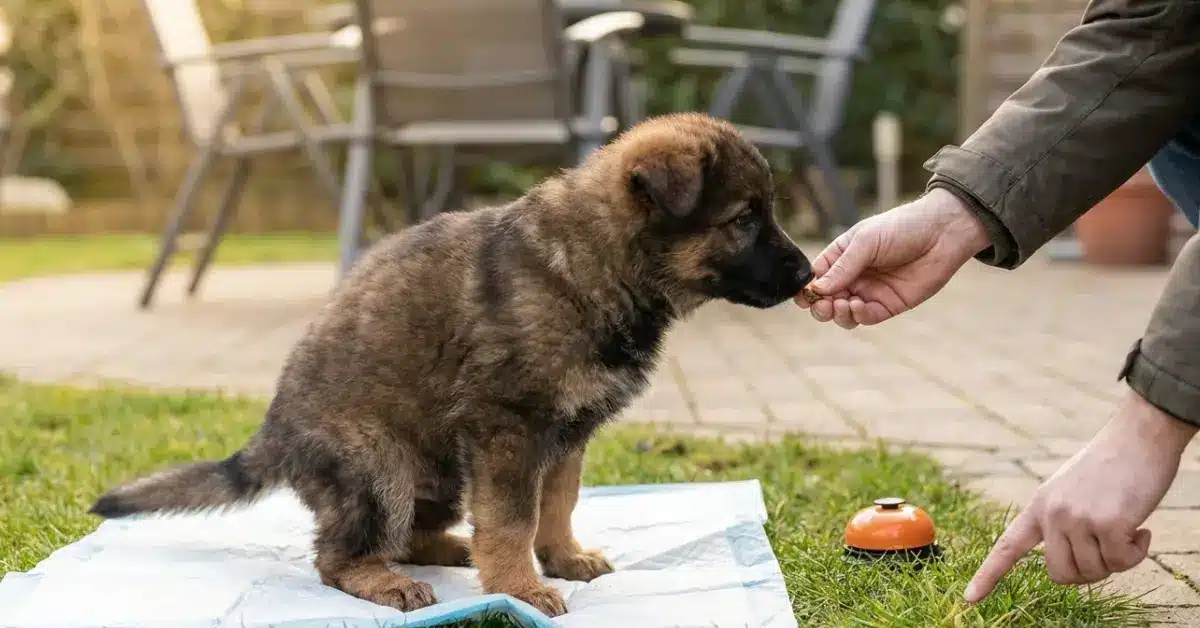
Some owners use pads temporarily. If you do, place them near the door and fade them out gradually.
How to Potty Train a Female German Shepherd Puppy
The process is the same for males and females, but there can be small differences.
Female puppies often:
- Mature slightly earlier
- Show clearer squat signals
- Urinate in smaller amounts more frequently
One female puppy I helped train would squat several times during one walk. The owner thought she wasn’t finished and stayed outside too long. Shorter, more frequent trips solved the issue.
If you’re wondering how to potty train a female German Shepherd puppy, focus on routine and observation rather than changing the method.
Night-Time Potty Training: What’s Normal
Most puppies can’t sleep through the night right away.
Helpful adjustments:
- Remove water two hours before bed
- Last potty trip as late as possible
- Keep night outings boring
- Carry the puppy if needed
One puppy consistently had accidents around 3 a.m. Adding a quiet 2:45 a.m. potty break for a few weeks fixed the problem. Eventually, the puppy slept through the night on their own.
Common Mistakes That Slow Training
These mistakes show up again and again.
- Giving too much freedom too early
- Inconsistent feeding times
- Missing subtle signals
- Using the wrong cleaner
Each one delays learning more than people realize.
Comparing Potty Training Approaches
|
Method |
Best For |
Limitations |
|
Crate training |
Most homes | Requires consistency |
| Puppy pads | High-rise apartments |
Can delay outdoor habits |
| Bell training | Older puppies |
Needs foundation first |
In most real homes, crate training paired with outdoor routines works best long-term.
When Potty Training Isn’t Improving
If accidents continue past six months, look deeper.
Possible causes include:
- Urinary tract infections
- Anxiety
- Inconsistent schedules
- Too much unsupervised time
I once saw a puppy labeled “stubborn” who turned out to have a mild urinary infection. After treatment, the puppy became reliable within two weeks. Health issues are more common than people think.
Signs Potty Training Is Working
Progress often shows up quietly.
Look for:
- Longer dry periods
- Puppy heading toward the door
- Shorter potty trips
- Predictable timing after meals
These small signs mean habits are forming.
Final Thoughts
Potty training a German Shepherd puppy isn’t about control—it’s about clarity. The owners who succeed aren’t perfect. They’re consistent, observant, and patient. Accidents don’t mean failure. They mean the system needs adjusting.
Stick with the routine. Pay attention to patterns. Trust the process. One day you’ll realize it’s been weeks since the last accident—and that’s when you know the training worked.
FAQs
1. How do I potty train my German Shepherd puppy faster?
Consistency, close supervision, and immediate rewards help most.
2. At what age should a German Shepherd be potty trained completely?
Most puppies are reliable by six months with steady routines.
3. Can German Shepherd housebreaking be done without a crate?
Yes, but it usually takes longer and requires constant supervision.
4. How long can a German Shepherd puppy hold pee?
Roughly one hour per month of age, plus one extra hour.
5. Is potty training harder for first-time German Shepherd owners?
Not if routines are followed. This breed learns quickly.
6. How should accidents be handled during training?
Clean thoroughly and adjust supervision. Never punish.
7. Does potty training differ between male and female puppies?
The process is the same, though individual maturity varies.
8. What if my puppy only has nighttime accidents?
Adjust evening routines and add one scheduled night potty break.