If you’ve just brought home a fluffy, energetic German Shepherd puppy, you already know one thing—this breed is smart, eager to learn, and full of opinions. Crate training German Shepherd puppy early helps turn all that potential into good habits. I’ve crate trained multiple GSD puppies over the years, and while each one had their quirks, the process always followed the same rhythm. In this guide, I’ll walk you through what has consistently worked for me and for the families I’ve trained, including how to build a simple crate training schedule for puppies that actually fits your life.
Why Crate Training Works So Well for German Shepherds
German Shepherds love structure. They thrive when they understand what’s expected of them. A crate gives them:
- A quiet, cozy zone to unwind
- A safe place when you can’t supervise
- A foundation for housebreaking
- A way to prevent destructive habits
One of my shepherds practically trained herself once she decided the crate was her “bedroom.” Another pup, however, acted like the crate was lava for the first week. Both got there—just at different speeds. That’s normal.
Choosing the Right Crate Size for a German Shepherd Puppy
You’re training a puppy that will grow into a large, athletic dog, but don’t buy the biggest crate you can find and give them the whole thing at once. Large open space can encourage accidents.
Here’s what usually works:
- Choose a large crate with a divider panel
- Start small and expand the space as your puppy grows
- Ensure the puppy can stand up, turn around, and lie down comfortably
A crate that’s too big slows down housebreaking. A crate that’s too small makes the puppy fight it. The divider lets you adjust the size week by week.
Introduce the Crate Slowly (Day 1–3)
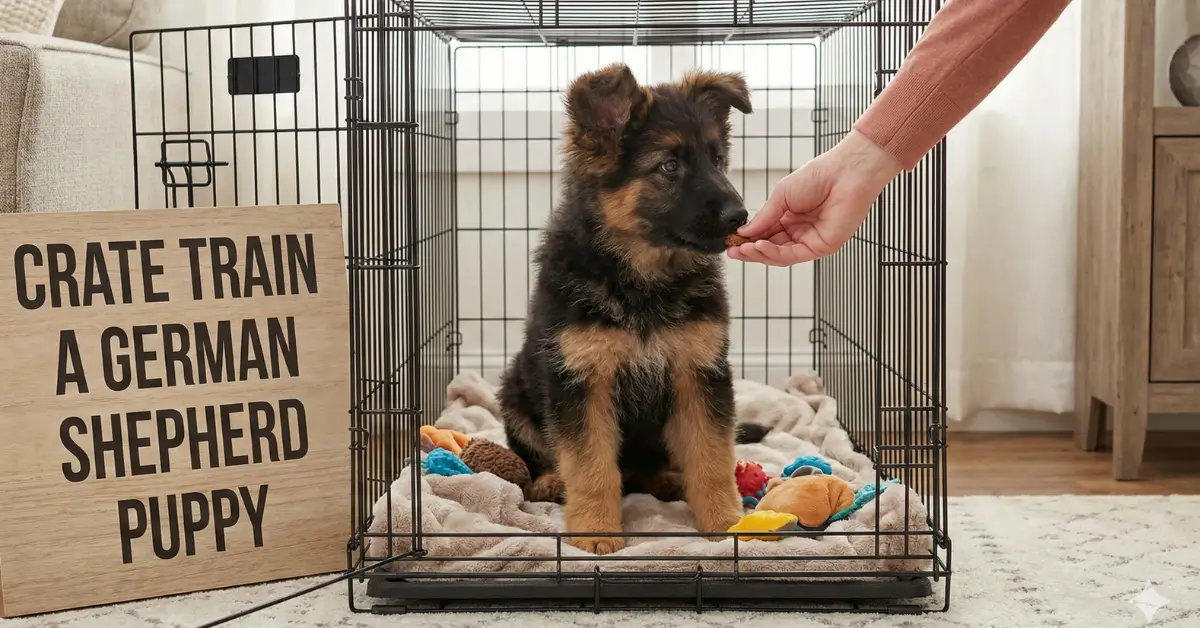
Don’t just put your puppy in the crate and shut the door. Let them form a positive association first. I usually start with something simple:
Make the crate inviting
- Place a soft blanket
- Add a favorite toy
- Keep the door open
- Toss treats inside casually
Let the puppy wander in on their own. A few minutes at a time is enough at first.
What I usually see in the first few days
One puppy of mine kept sneaking into the crate on her own, taking little naps. Another wouldn’t go in unless I dropped a treat inside. Both behaviors are okay—your goal is comfort, not perfection.
Step-by-Step Crate Training Plan (The First 2 Weeks)
This is the practical part most owners need. Below is a simple routine that mirrors real life. Adjust to your schedule as needed.
Step 1: Short sessions while you’re nearby
Start with 10–15 minutes while sitting next to the crate. Your puppy should see you as calm and present.
Step 2: Increase duration slowly
Move from 15 minutes to 30. Then an hour. This process can take a few days, depending on the puppy’s confidence.
Step 3: Pair crate time with naps
Puppies sleep a lot. Use their tired state to your advantage by placing them in the crate right before naptime.
Step 4: Keep departures very boring
No emotional exits. Just a simple “be right back.”
Step 5: Release after calm behavior
Do not open the door when they’re whining. Wait a few seconds of silence, then open gently. Otherwise, they learn that whining opens doors.
Sample Crate Training Schedule for Puppies (Easy to Follow)
This schedule fits most 8–12-week-old German Shepherd puppies. Use it as a starting point and adjust based on your daily routine.
|
Time of Day |
Action | Notes |
|
Morning |
Potty → Breakfast → Short play |
Always potty first |
|
After breakfast |
Crate time: 60–90 minutes |
Ideal for work-from-home routines |
|
Mid-morning |
Potty → Play → Training |
Keep sessions short |
|
Lunch |
Crate time: 60 minutes |
Adjust based on puppy |
|
Afternoon |
Potty → Walk → Social time |
Helps burn energy |
|
Evening |
Crate time: 30–60 minutes |
Good for prepping dinner |
| Night | Potty → Bedtime in crate |
Keep it dark and quiet |
This is not a rigid rulebook—just a rhythm that tends to work for most families.
How Long Can a German Shepherd Puppy Stay in the Crate?
A good baseline:
- 8-week-old puppy: 1–2 hours
- 10–12 weeks: 2–3 hours
- 14–16 weeks: 3–4 hours
At night, puppies can typically go longer because their bodies slow down while sleeping.
Crate Training Schedule for an 8-Week-Old Puppy
This age is when many owners struggle, especially with night-time crate training. An 8-week-old is still adjusting to your home, so keep expectations realistic.
What works well at this age
- Keep crate sessions short during the day
- Use more frequent potty breaks (every 1.5–2 hours)
- Maintain a soft, reassuring voice when they settle in
- Keep nighttime potty breaks calm and half-asleep
I’ve helped owners who felt like the first week was chaos, and then suddenly, the puppy understood the routine and everything improved almost overnight.
Crate Training Schedule for an 8-Week-Old Puppy at Night
Nighttime training is usually the hardest part for new owners.
A simple night routine that works well:
- Last potty break around 10:00–11:00 PM
- Into the crate with a soft light off
- Expect 1–2 wake-ups during the night for potty breaks
- Take the puppy straight out, no play, no talking
- Back into the crate gently
The goal is to avoid fully waking the puppy. Night-time crate training for a German Shepherd is manageable when you keep it boring and predictable.
Housebreaking a German Shepherd Puppy Using the Crate
The crate is one of the best tools for housebreaking. Puppies naturally avoid soiling their sleeping space.
Tips that consistently work
- Take the puppy outside immediately after crate time
- Use a consistent location to potty
- Praise with a quiet, happy voice when they finish
- Clean accidents with an enzyme cleaner so the scent doesn’t linger
A predictable potty training schedule for your puppy makes everything easier. Most accidents happen when owners lose track of time, not because the puppy doesn’t understand the rules.
Creating a Crate Potty Training Schedule
If your puppy is struggling with accidents, use a tight potty rhythm:
- After sleep
- After eating
- After playing
- Every 1.5–2 hours in between
GSD puppies have strong instincts but immature bladders. Patience pays off.
What Your Puppy’s Crate Training Timeline Should Look Like
Every puppy learns at a slightly different pace, but here’s the general timeline I’ve seen across multiple German Shepherds:
Week 1
- Lots of whining at night
- Short daytime crate sessions
- Frequent potty breaks
Week 2
- Puppy settles faster in the crate
- Less whining at night
- Fewer accidents
Week 3–4
- Puppy goes into the crate willingly
- Holds bladder longer
- More reliable when left alone
8–12 weeks
- Puppy views crate as safe space
- Naps in crate without prompting
- Good progress with housebreaking
A puppy crate training schedule for 12 weeks usually becomes much smoother, and the process feels less chaotic.
Common Mistakes Owners Make During Crate Training
These mistakes drag the process out, and I’ve made a few myself over the years.
1. Using the crate as punishment
Never call the crate “time-out.” Your shepherd should love going inside.
2. Leaving the puppy too long
Over-crating creates stress and makes training backfire.
3. Letting the puppy out when they cry
This teaches them exactly the wrong thing.
4. Skipping the routine
Consistency is everything with German Shepherds.
5. Ignoring the puppy’s energy needs
A tired puppy trains better. Always.
People Also Ask
How long does crate training usually take?
For most German Shepherd puppies, you’ll see real progress in about 2–4 weeks. By 12 weeks, it feels natural.
Should I put food and water in the crate?
Food is fine during mealtimes. Water is usually not needed unless your vet says otherwise.
When do puppies stop needing nighttime potty breaks?
Many GSD puppies make it through the night by 12–14 weeks.
Why does my puppy cry so much in the crate?
It’s usually from separation anxiety, overstimulation, or too much daytime freedom.
Does crate training help with biting and chewing?
Absolutely. It prevents overstimulation and gives your puppy a safe cooldown space.
Troubleshooting Whining, Barking, and Anxiety
If your puppy is struggling, here’s what usually helps:
- Cover the crate with a light blanket
- Move the crate closer to your bed at night
- Add a warm snuggle toy with a heartbeat sound
- Increase exercise during the day
- Shorten crate sessions temporarily
I once had a shepherd who only calmed down when the crate was placed near a window with a soft fan on. Sometimes small changes make the biggest difference.
When to Expand the Crate Area
Use the divider to expand the crate gradually:
- No accidents for 5–7 days → increase space
- One accident → reduce space again
- Puppy sleeps comfortably → expand a little more
Think of it as training wheels. Expand only when ready.
When You Can Start Leaving Your Puppy Alone in the Crate
Most German Shepherd puppies do well with being home alone for short periods around 10–12 weeks when:
- They’re comfortable in the crate
- They have a dependable potty rhythm
- They’re tired before the session
Try 30 minutes first. Then 1 hour. Then 2. Build up slowly.
Final Thoughts: Crate Training Should Make Life Easier, Not Harder
Crate training a German Shepherd puppy doesn’t happen overnight, but it’s one of the best investments you can make. Once your puppy understands the routine, everything—from housebreaking to chewing control—becomes easier.
Take it one day at a time, follow a consistent rhythm, and celebrate the small wins. Your puppy will eventually view the crate not as a cage but as their own little den. And that’s when the real transformation happens.
FAQs
1. How do I build a simple crate training schedule for an 8-week-old puppy?
Start with short sessions, frequent potty breaks, and calm nighttime routines. Keep the crate time around 1–1.5 hours between outings.
2. Is a crate useful for potty training schedule puppy routines?
Yes. The crate helps puppies hold their bladder and learn predictable potty patterns.
3. Can I follow the same crate training schedule for 8-week-old and 12-week-old puppies?
Not exactly. A puppy crate training schedule for 12 weeks allows for longer crate sessions and fewer potty breaks.
4. What should I do if my German Shepherd cries at night in the crate?
Stay calm, offer reassurance without opening the crate, and maintain a steady routine for night-time crate training.
5. How often should I take my puppy out to potty during crate training?
Typically every 1.5–2 hours for very young puppies, extending to 3–4 hours as they grow.
6. Does a strict crate training routine help with housebreaking?
Yes. German Shepherds respond very well to structure, and a crate potty training schedule strengthens that structure.
7. Should my puppy nap in the crate every day?
Daily naps help reinforce the crate as a positive, relaxing space.
8. When does crate training become easier?
Most owners notice big improvements around 10–12 weeks as the puppy adjusts to the crate training puppy timeline.