If you’ve brought home a German Shepherd puppy, you already know how adorable, smart, and full of energy they are. But there’s one thing almost every GSD owner struggles with in the beginning: German Shepherd puppy biting. Those tiny shark-like teeth can hurt, and the constant nipping can make training feel overwhelming.
If it makes you feel any better, this phase is totally normal. I’ve raised multiple shepherds over the years, and almost all went through the “I want to chew everything—including your hands” stage. The good news? With the right approach and a bit of patience, you can teach your puppy to stop biting.
This guide shares the exact methods that have worked for me and countless GSD owners, explained in a simple, warm, and realistic way.
How to Stop German Shepherd Puppy Biting
Understanding Why Your German Shepherd Puppy Bites
Before you try to fix the behavior, it really helps to understand what’s going on in your puppy’s mind. German Shepherd puppies explore the world with their mouths. That includes hands, legs, shoes, furniture—almost anything.
Here are some real reasons behind German Shepherd puppies and biting:
They’re Teething
Just like human babies, puppies go through teething discomfort between 3–6 months. Biting gives them relief.
Play Behavior
In the litter, puppies bite each other to play. When one puppy bites too hard, the other yelps and walks away. That’s how they learn bite inhibition. Your puppy is simply repeating what they know.
Herding Instinct
GSDs are herding dogs. They naturally nip at heels to control movement. So when your puppy grabs your pant leg, they’re not being aggressive—they’re following instinct.
Lack of Training or Stimulation
A bored German Shepherd puppy is a nippy puppy. These dogs are incredibly smart. If their brain and body aren’t challenged, they release energy in the form of biting.
Overexcitement
When puppies get thrilled – especially during play – they don’t know when to stop.
Is German Shepherd Puppy Biting Normal?
Absolutely. Every GSD I’ve owned or trained went through a nipping phase. It usually peaks around 8–12 weeks and gradually improves with consistent training.
If you’ve been wondering, “When will my German Shepherd puppy stop biting?”—most puppies outgrow this stage by 6–9 months, but only if you guide them the right way.
Some take a bit longer. It depends on genetics, training consistency, and how the owner reacts to biting.
Common Mistakes That Make Biting Worse
Sometimes we accidentally encourage biting without realizing it. A few things that create more problems:
- Pulling your hand away quickly (puppy thinks it’s a chasing game)
- Laughing or reacting loudly
- Allowing rough play
- Encouraging hand-play when the puppy is young
- Not giving enough chew toys
- Inconsistent corrections
- Letting children play unsupervised
I’ve made some of these mistakes myself. But once corrected, the improvement was immediate.
How to Stop Your German Shepherd Puppy from Biting (Step-by-Step)
Below is a simple, practical training approach that works for almost all GSD puppies.
Step 1: Redirect the Bite
When your puppy starts biting your hands or clothes, don’t pull away. Instead:
- Stay calm
- Say a firm, gentle “No” or “Ah-ah”
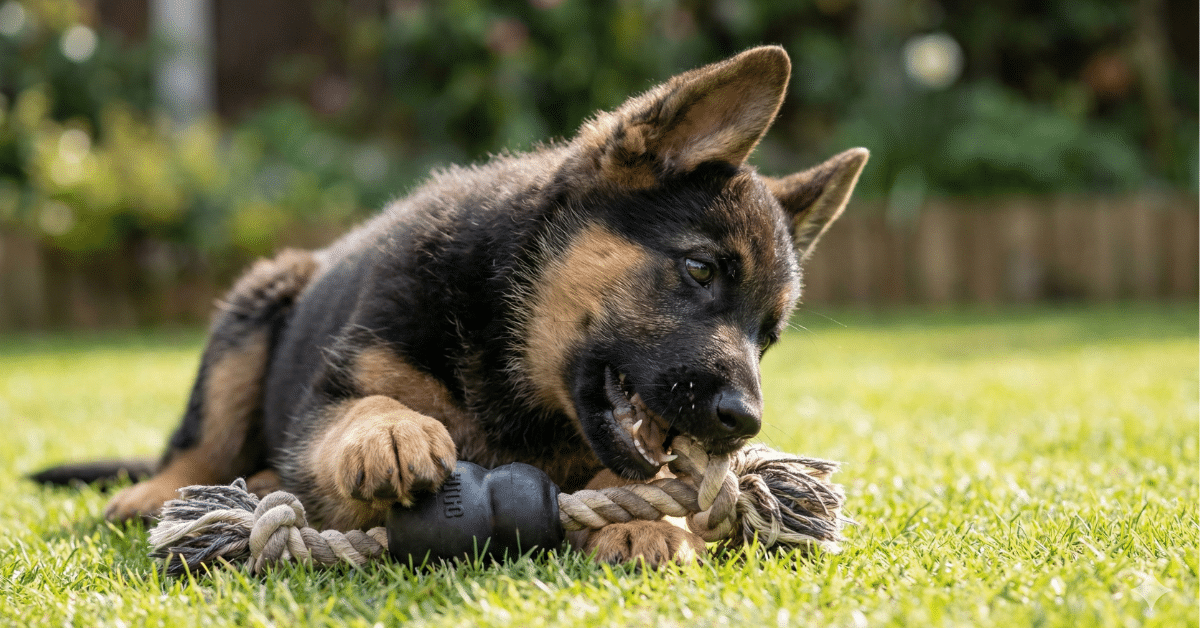
- Immediately offer a chew toy
This teaches your puppy:
- Hands are not for biting
- Toys are for biting
I always keep 2–3 chew options within reach. Redirection works better than punishment and helps the puppy learn without fear.
Step 2: Use the “Yelp and Ignore” Technique
This is similar to how puppies train each other.
Here’s how to do it:
- Puppy bites too hard
- You make a short “Ow!” sound
- Stop interacting and turn away
- Wait 5–10 seconds
- Resume play when the puppy calms down
This teaches bite inhibition and reduces overexcited nipping.
Step 3: Teach “Leave It” Early
This command is a lifesaver. It works for biting, picking up objects, and impulse control.
To teach it:
- Hold a treat in your hand
- When your puppy tries to get it, close your fist
- The moment they stop trying, say “Leave it”
- Reward with a different treat
Practice for 5 minutes daily.
Step 4: Stop Rough Play
German Shepherd puppy nipping often increases with rough games like:
- Tug-of-war (if not controlled)
- Wrestling
- Running wildly indoors
Switch to calmer bonding:
- Puzzle toys
- Obedience training
- Hide-and-seek
- Gentle fetch
Your puppy’s energy finds a safer outlet.
Step 5: Give Enough Exercise (Physical + Mental)
A tired GSD puppy is a well-behaved puppy. Simple rule.
Daily exercise needs:
- 5 minutes of structured exercise per month of age
- Mental stimulation (training, sniffing games)
If you skip this, the extra energy often comes out through biting.
Step 6: Socialization
Socialization teaches puppies how to behave around:
- Other dogs
- New people
- Different environments
When they play with other puppies, they quickly learn how hard is “too hard.” That reduces nipping at home.
Step 7: Use Time-Outs for Persistent Biting
If nothing works and biting escalates, use a time-out.
How to do it:
- No yelling
- No physical punishment
- Calmly remove the puppy from the room
- Wait 20–30 seconds
- Bring them back
Time-outs help the puppy understand that biting ends all fun.
Step 8: Avoid Punishment
Never:
- Hit
- Alpha-roll
- Flick the nose
- Hold the mouth shut
These methods create fear and make biting worse.
Positive training works faster and builds trust.
Comparing Correct vs. Incorrect Responses to Puppy Biting
| Situation | Wrong Response | Correct Response |
| Puppy bites your hand | Pulling away fast | Staying calm + redirecting |
| Puppy bites during play | Laughing or getting excited | Stopping play immediately |
| Puppy bites your legs | Chasing them around | Standing still + offering toy |
| Puppy keeps biting | Yelling | Giving a short time-out |
Success comes from calm, consistent reactions.
Signs Your Training Is Working
You’ll notice small improvements first:
- Biting becomes gentler
- Puppy pauses instead of lunging
- Redirecting becomes easier
- Play stays calmer
- Nipping reduces during excitement
These small wins add up. Most GSD puppies improve within a few weeks of consistent practice.
People Also Ask
1. Why does my German Shepherd puppy bite me so much?
Most puppies bite out of instinct, teething discomfort, or excitement. German Shepherds also have a natural herding instinct, so they often nip at heels and hands.
2. Is my German Shepherd puppy being aggressive when it bites?
Aggression in puppies is rare. Most biting is playful, curious, or instinct-driven. True aggression usually includes growling, stiff posture, and a hard stare, which typical puppy nipping does not.
3. How long does the GSD puppy biting phase last?
The gsd puppy biting phase usually improves around 5–6 months but can last until 9 months if training is inconsistent. With proper redirection, most puppies stop hard biting very quickly.
4. Should I let my German Shepherd puppy bite when playing?
No—allowing hand biting teaches bad habits. Always redirect to a toy and avoid rough play.
When to Worry About Biting
Sometimes biting can signal something more serious. Pay attention if your puppy:
- Growls with a stiff, rigid body
- Guards toys or food
- Snaps without warning
- Shows fear around the family
These cases may need a professional trainer. But honestly, in most homes, puppy biting is simply a normal phase—not aggression.
Extra Tips That Help Faster
Here are a few simple things that made a big difference for my puppies:
1. Keep Toys Everywhere
Have:
- Rope toys
- Rubber chew toys
- Teething toys
- Plush toys
A quick redirect is easier when you have options.
2. Teach Calmness Early
Reward your puppy when they sit calmly. Calm puppies bite less.
3. Use Frozen Teething Toys
Great for soothing sore gums.
4. Limit Overstimulation
Too much excitement = more biting.
5. Short, Frequent Training Sessions
3–5 minutes several times a day works better than long sessions.
How Long Until Your German Shepherd Puppy Stops Biting?
Most GSD puppies stop biting excessively around 6–9 months. Some calm down earlier, especially if trained from the first week at home. Others take a bit longer, especially if they’re high-energy or not getting enough exercise.
But trust me—this phase doesn’t last forever.
Conclusion
German Shepherd puppies are smart, mouthy, and full of energy. Biting is part of their learning and growing. With the right mix of training, redirection, exercise, and patience, your puppy will understand what’s acceptable.
If you stay calm and consistent, the biting will stop sooner than you think. And one day, you’ll look back and laugh at how those tiny teeth once ruled your life.
Your future well-behaved GSD starts with the simple steps you take today.
FAQs
1. Do German Shepherd puppies bite more than other breeds?
Yes, they usually do. Their herding instincts and high energy make german shepherd puppy nipping more common compared to many other breeds.
2. Will my German Shepherd puppy grow out of biting without training?
Not fully. The biting may reduce as they mature, but without guidance, the habit can continue into adulthood.
3. Does teething make German Shepherd puppies bite more?
Yes. Teething increases mouth discomfort, so puppies often chew or nip to relieve the pressure.
4. Is it okay to use treats to stop biting?
Treats help when teaching commands like “Leave it,” but don’t reward right after a bite. Redirect first, then reward calm behavior.
5. Can exercise help reduce biting?
Absolutely. A tired GSD puppy is far less likely to bite from frustration or boredom.
6. Is biting a sign of dominance?
No. Most puppy biting is not dominance—it’s developmental, instinctive, or a response to excitement.
7. How do I stop my German Shepherd from biting my kids?
Supervise all interactions, teach kids to stay calm, and redirect biting to toys. Also ensure your puppy isn’t overstimulated.
8. Can training classes help reduce biting?
Yes. Puppy classes improve socialization, confidence, and impulse control—all of which reduce nipping behavior.